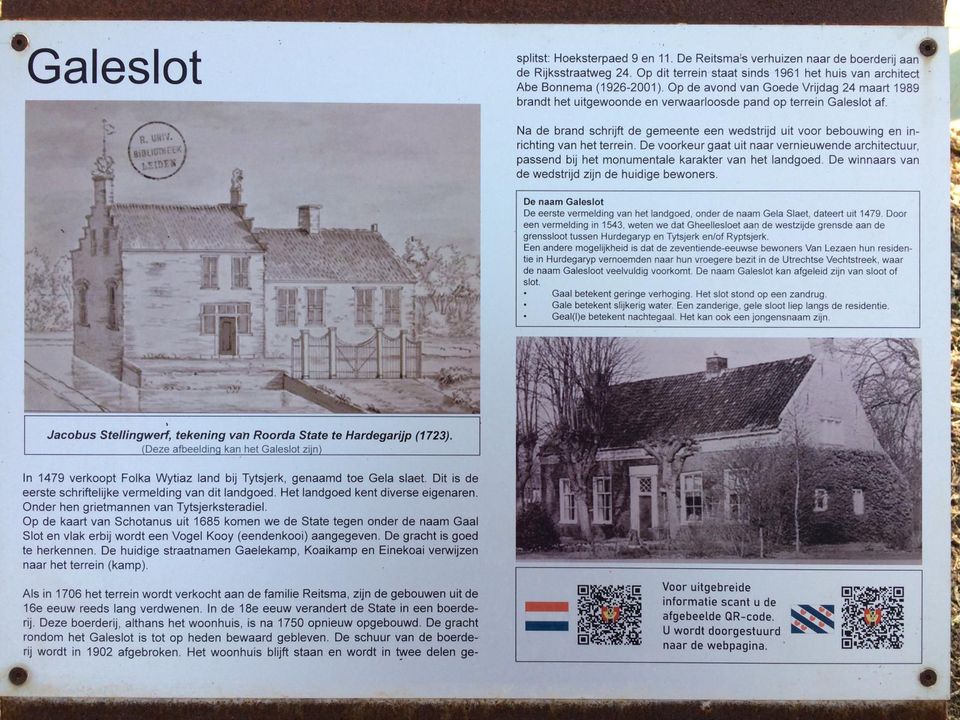
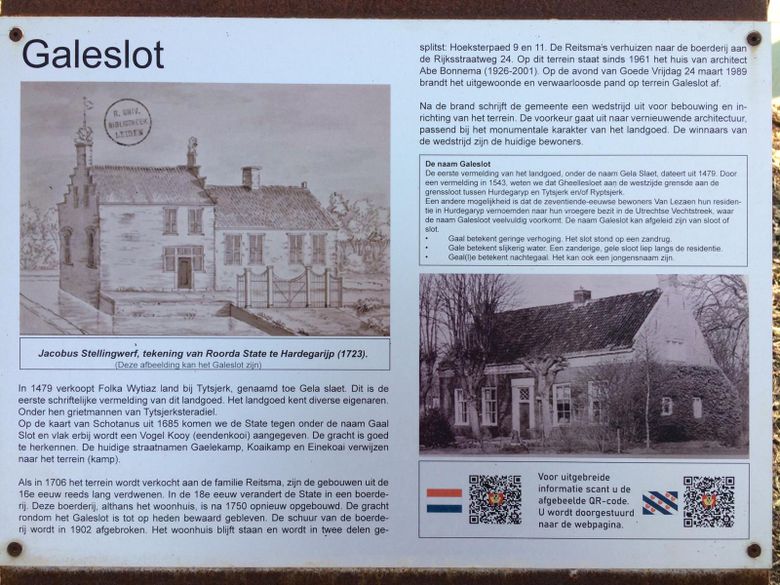
In 1479 Folka Wytiaz sells land near Tytsjerk, called toe Gela slaet. This is the first written mention of this estate.
Along the Oude Weg (Suwâldsterdyk) between Hurdegaryp and Tytsjerk there was a stinswier in 1718, according to the map of Schotanus and Halma. Perhaps the seaweed can be seen as a predecessor of the house of Galeslot. In the 16th century, a mansion was founded here, which was probably owned by the Rataller family of civil servants. Galeslot is said to have a similar background as the neighboring Toutenburg in Swarteweisein below Ryptsjerk.
Between 1531 and 1543 Jeroen van Rataller is the owner. In those years he was grietman of Tytsjerksteradiel and was succeeded by Johan van Rataller (†1590), who was grietman from 1549 to 1584. His daughter Genoveva inherits Galeslot from him. She married Wolphaert van Lezaen, who succeeded her father as grietman in 1584. Both Genoveva and Wolphaert are buried in Hurdegaryp.
This couple has one descendant: their daughter Ida van Lezaen. She married in 1613 to Sabe Jans van Wissema and in 1628 to Johan Watzes Roorda, as a result of which Galeslot came into the hands of the noble Van Roorda family and possibly received the name Roorda State.
In 1639, Ida van Lezaen made her will, in which she designated as the heir of Galeslot in order: Watze van Roorda (her youngest son), Duco Sabinus van Wissema (son from her first marriage) and the eldest of her children or grandchildren with the name Jan or Ida. After the death of Ida in 1648 and the death of Johan in 1657, their son Watze inherited from Roorda "the kostelycke zate ende landen, existende in een huisinge, schuyre, hovinge, bomen ende plantagie naam Gaeleslot". Galeslot is mentioned in 1664 as an important freehold state.
In 1670 Watze died childless. He was buried in the church on the Zomerweg, just like his grandparents Wolphaert and Ida van Lezaen. It was this Watze van Roorda who had the family pew placed in the previous church and thus bought his permanent place in the church. This gentleman's pew, with family coat of arms, was made around 1668 and was taken to the current church in 1711. After Watze's death, the State inherited Duco Sabinus van Wissema, a son from the first marriage of Ida van Lezaen, to Sabe Jans van Wissema. He is married to Frau Bockesdr Burmania. They died in 1678 and 1680 respectively, after which the State inherited to their eldest daughter Ida van Wissema, in accordance with the will of Ida van Lezaen.
On the map of Schotanus from 1685 we come across the State under the name Gaal Slot and close to it a Vogel Kooy (duck decoy) is indicated. The canals around the house are easily recognizable. The current street names Gaelekamp, Koaikamp and Einekoai refer to the site (camp).
When the site was sold to the Reitsma family in 1706, the buildings from the 16th century had long since disappeared. In the 18th century, the state changed into a farm. This farm, or at least the house, was rebuilt after 1750. The moat around the Galeslot has been preserved to this day. The archive shows that Gielt Claassen Reitsma is the owner in 1828 and Gerrit Gjalts Reitsma in 1832.
The barn of the farm was demolished in 1902. The house will remain and will be split into two parts: Hoeksterpaed 9 and 11. The Reitsma's move to the farm at Rijksstraatweg 24. The house of architect Abe Bonnema (1926-2001) has stood on this site since 1961. From 1706 to 1963, the Reitsma's owned Galeslot. The street name Reitsmaweg still refers to this influential family.
From 1936 the Sibma family lives at Hoeksterpaed 9. The Dijkstra family lived at number 11 from 1936 to 1952. The Lindeboom family has lived at this address since 1952. The wives of Theunis Sibma (1904-1976) and Reinder Lindeboom (1909-1982) are sisters: Jacoba (1909-1988) and Trijntje de Jong (1911-1994). Trijntje Lindeboom-de Jong is the last resident of the old Galeslot. On 23 February 1989 she left for a home for the elderly at Sinderhôven 188.
In 1963 the site with buildings was sold by the Reitsma family to the municipality of Tytsjerksteradiel under the following condition: "To maintain the current landscape character of the real estate ..., consisting of a residential house with yard and garden, bordered by a moat with wood, as a whole, on the understanding that rebuilding, extension or renovation of the house, taking into account the housing requirements applicable at that time."
On the evening of Good Friday, March 24, 1989, the dilapidated and neglected building burns down. The large lime tree on the far right behind the house, probably planted after the demolition of the stable in 1902, was also damaged by the fire, but still stands proudly today, as do the lime trees in front of the house and the holly in the bottom left corner.
After the fire, the municipality organizes a competition for construction and layout of the site. The preference is for innovative architecture, in keeping with the monumental character of the estate. The winners of the competition are the current residents.