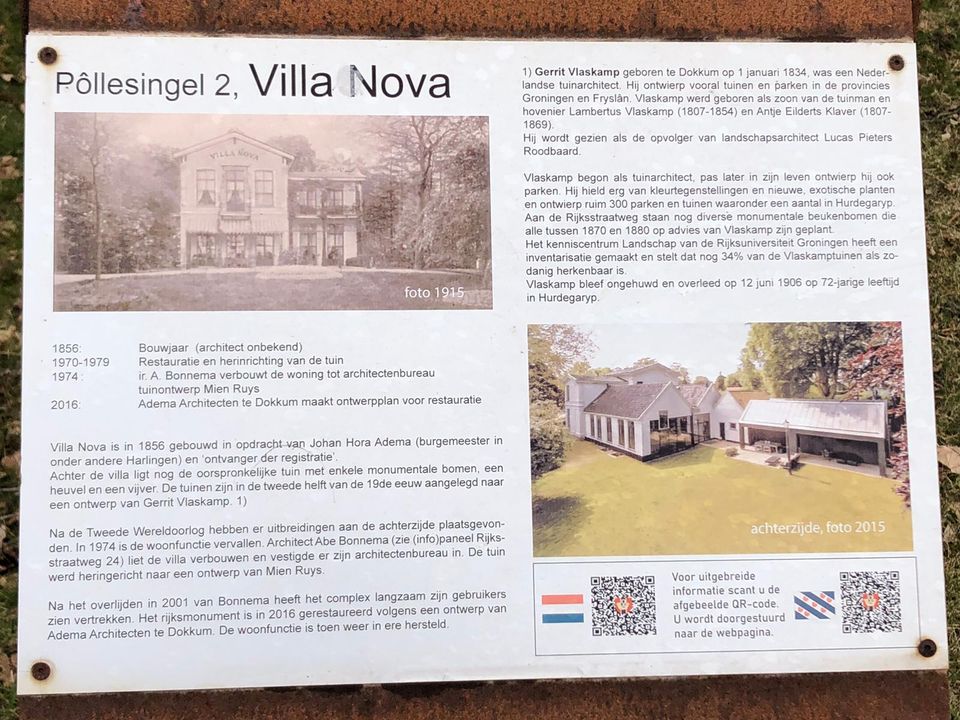
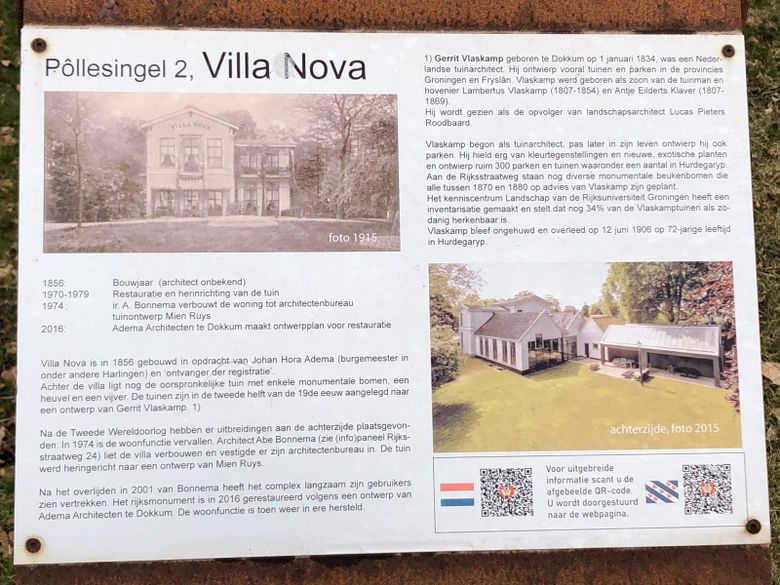
Villa Nova is a listed national monument built in 1856, commissioned by Johan Hora Adema (registrar of deeds). The villa is a striking example of eclectic architecture, set on a prominent corner location at the Pôllesingel, with its front façade facing what was for many years an important through-road. The accompanying cast-iron fencing from the same year is part of the monument’s character and still marks the entrance.
From 1887 until his death in 1937, Villa Nova was home to Hendrik P. Smids; after that, it had various residents. Behind the villa you’ll find the original garden with a pond, a small hill and several monumental trees, laid out in the late 19th century to a design by Gerrit Vlaskamp. After WWII, extensions were added at the rear (these are not included in the protected monument status).
In 1974, the residential function ended when architect Abe Bonnema converted the building into his architectural office. The front garden was redesigned by Mien Ruys. Following Bonnema’s death in 2001, the complex gradually became quieter, until a careful restoration in 2016 (Adema Architecten, Dokkum) brought Villa Nova back to life and restored its original use as a residence.