Locations
1513 to 1536 of 2711 results
-
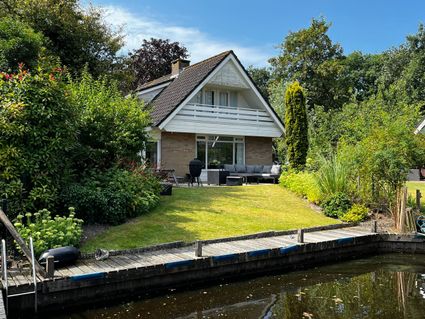
Vakantiewoning Waterwende 29
Vakantiewoning Waterwende 29 Indijk
Book now
-
Yachtcharter Friesland
Yachtcharter Friesland Grou
-
Lutz Watervilla's - Wettervilla Seis
Lutz Watervilla's - Wettervilla Seis Balk
Book now
-
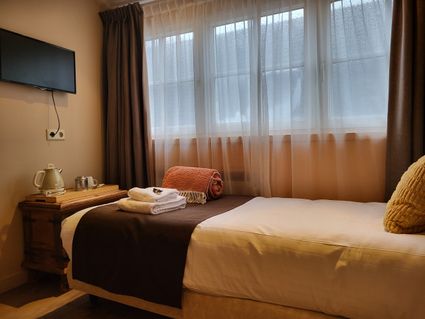
Parkhotel Tjaarda - Comfortkamer
Parkhotel Tjaarda - Comfortkamer Oranjewoud
Book now
-
Outdoor cooking
Outdoor cooking Vlieland
-
WestCord WTC Hotel - Family Room Comfort
WestCord WTC Hotel - Family Room Comfort Leeuwarden
Book now
-
B&B Gaasterland-Hoeve 44
B&B Gaasterland-Hoeve 44 Wijckel
-
Villa Sun
Villa Sun Ballum
-
British War Cemetery Harlingen
British War Cemetery Harlingen Harlingen
-
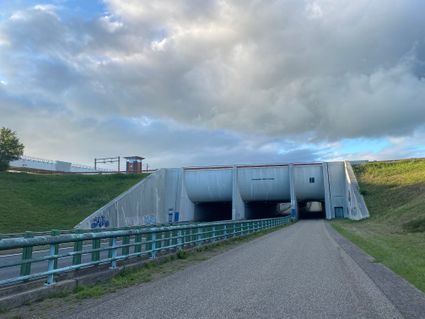
Remains of the Atlantic Wall in Harlingen
The bunkers at Harlingen were part of the Atlantic Wall: the more than 6,000-kilometer-long German defense line from Norway to Spain. The Atlantic Wall is one of the largest structures of the 20th century.
The line was built during the Second World War between 1942 and 1945 to prevent an Allied invasion of the Western European mainland from the sea. The Atlantic Wall was a series of separate smaller and larger support points that could give each other fire support.
In many cases they consisted of bombproof bunkers, sometimes with a wall and roof thickness of at least two meters of reinforced concrete. Due to a lack of labour, equipment and fuel, only 510 bunkers of the planned 2000 had been built in the Netherlands. In the English Garden in Harlingen is a German bunker that was part of the Atlantic Wall. It concerns a Communications Command Post with which the Germans coordinated the Frisian coastal defences.
Harlingen
-
Camping Oan e Poel - Stacaravan Bruine Beer
Camping Oan e Poel - Stacaravan Bruine Beer Heeg
Book now
-
it Mirnserklif near Mirns
it Mirnserklif near Mirns Mirns
-
BinnenInn 12-Person House
BinnenInn 12-Person House Metslawier
-
Headmaster Jakob Klok in the resistance
During the war, Jakob (Jaap) Klok ended up in the resistance in Dantumadeel, where he played an important role. At the time, he lived with his wife and four children in Akkerwoude, where he was headmaster of the school at Hearewei 13. He stayed there until 1947 and will always be remembered as "Headmaster Klok."
Jaap Klok was active socially and in politics as a member of the Dutch Social Democratic Labour Party (SDAP). When party meetings were banned by the German occupiers, Jaap imperceptibly became ever more involved in resistance activities. He passed on party information, distributed illegal newspapers, and looked for addresses for people in hiding. Jaap Klok joined the LO, the National Organisation for Aid to people in Hiding, and became the Akkerwoude village commander.
Although people did not know exactly what he did, it was known that he was in the resistance. Despite the fact that his name circulated among NSB members, he decided not to go into hiding, but instead tried to be even more careful and to sleep at home more often than not.
As the war drew to a close, Jaap became very busy. The Dutch government in exile was calling on railway workers to go on strike. The resistance arranged for the hiding. On 15 December 1944, a group of about sixty refugees from Arnhem arrived at his school. Jaap was indirectly involved in the evacuation committee, which was looking for addresses for the unfortunate Arnhem residents.
Shortly thereafter, he was warned at the schoolhouse that during a raid in Murmerwoude, explicit questions were asked about schoolmaster Klok. Jaap did not hesitate a second and quickly left the house. And not a moment too soon, as ten minutes after his departure the Germans were already on his doorstep. From that moment on, Jaap knew that he had to be very careful. He hardly ever slept at home anymore.
From January 1945 onwards, the situation became explosive. After the discovery of weapons on a farm in Aalsum, the Germans became fanatical. They relentlessly hunted down resistance fighters and used any means to make those who were caught talk. The name "Jaap Klok" was also mentioned during these interrogations. Sufficient reason to leave then and there, with his whole family. The children stayed with relatives. He and his wife went into hiding elsewhere.
During the last weeks of the war, Jaap was very busy. Much had to be organised and discussed within the resistance to expel the Germans and prepare for the arrival of the Canadians. Just before Dantumadeel was liberated, the inhabitants were already beside themselves with joy. They raised the flag and took to the streets en masse to celebrate. Because of his resistance work, Jaap knew exactly what the situation was with regard to the liberation. He climbed onto the balcony of the town hall and addressed the people. After all, the danger had not yet passed. Even when that was the case shortly thereafter, he ensured that peace was maintained among the population of Dantumadeel and thus prevented the molestation of a number of NSB members.
After the war, he held many administrative positions in the province of Friesland. In 1984, Jaap Klok died at the age of 91. Fifteen years later, a statue of him was erected in Akkerwoude, which was then called Damwoude, as a tribute.
From the book "De oorlog een gezicht geven" (deel 6) – Dantumadeel in de periode '40 - '45 by Yvonne te Nijenhuis and Reinder H. Postma
Damwald
-
Marina Resort Hart van Friesland
Marina Resort Hart van Friesland Uitwellingerga
-
The Music Box
The Music Box Leeuwarden
-
Soestpolder Nature Reserve
Soestpolder Nature Reserve Burgum
-
it Dreamlân nature campsite
it Dreamlân nature campsite Kollumerpomp
-
Houseboat Lemmer - Houseboat Lemmer
Houseboat Lemmer - Houseboat Lemmer Lemmer
Book now
-
Holiday Cottage It Koaiûs
Holiday Cottage It Koaiûs Jistrum
-
Café-Restaurant ’t Raedhûs
Café-Restaurant ’t Raedhûs Dokkum
-
Hotel 't Schippershuis - Comfort kamer
Hotel 't Schippershuis - Comfort kamer Terherne
Book now
-
B&B Wetterwillefriesland
B&B Wetterwillefriesland Wommels
-
WierSter Nocturnal Wildlife Garden
WierSter Nocturnal Wildlife Garden Wier