Locations
1225 to 1248 of 2385 results
-
Camping Flapper - Blokhut 'Wylde Swan'
Camping Flapper - Blokhut 'Wylde Swan' Gaastmeer
Book now
-
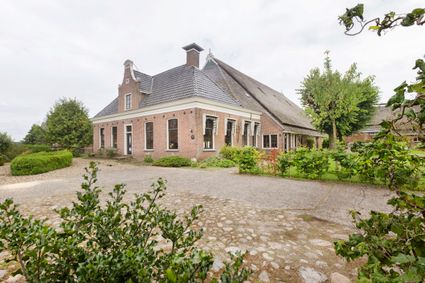
Ravenswoud
Ravenswoud Ravenswoud
-
B&B Zandhuizen
B&B Zandhuizen Zandhuizen
-
Boutiquehotel & Grandcafé 't Gerecht - Junior Suite
Boutiquehotel & Grandcafé 't Gerecht - Junior Suite Heerenveen
Book now
-
Het Lindedal
Het Lindedal Steggerda
-
Hotel Workum
Hotel Workum Workum
Book now
-
Sanzi Yacht Charter - Walburga
Sanzi Yacht Charter - Walburga Sneek
Book now
-
Boutique Hotel Catshuis
Boutique Hotel Catshuis Leeuwarden

-
Zijda Yachting - Iselmar Elite
Zijda Yachting - Iselmar Elite Jirnsum
Book now
-
B&B Langweer - Kamer 3
B&B Langweer - Kamer 3 Langweer
Book now
-
Forest cabin Nooitgedacht
Forest cabin Nooitgedacht Appelscha
-
Pizzeria Sardegna
Pizzeria Sardegna Leeuwarden
-
Fierljepschans IJlst
Fierljepschans IJlst IJlst
Book now
-
Beach Resorts Makkum - Schakel+ 6 persoons
Beach Resorts Makkum - Schakel+ 6 persoons Makkum
Book now
-
Broken Jug
Broken Jug Harlingen
-
Sail-a-way Sneekermeer - Appartement 8-4
Sail-a-way Sneekermeer - Appartement 8-4 Offingawier
Book now
-
Ambush at Oldeholtpade
On 12 April, the bridge over the Tjonger in Mildam fell into the hands of the Royal Canadian Dragoons reconnaissance regiment. Because the occupier had blown up many other bridges, the Canadians attached great importance to preserving this bridge for the crossing of other Canadian units. That is why dozens of armoured cars, mobile artillery guns and numerous other vehicles were sent to Mildam that day to reinforce the bridgehead over the Tjonger.
In one of those armoured cars, a Staghound, was 24-year-old Trooper Wilfred Robert George Berry from Ontario. The young Canadian had volunteered for military service in Europe. And had already fought with the Royal Canadian Dragoons in Italy. At the end of February 1945, they were transferred to Northwest Europe.
For Berry, the war ended in Friesland. In Oldeholtpade, on the road to Wolvega, his vehicle drove into an ambush along with at least one other Staghound. In the vicinity of a broken-down German car, German soldiers had hidden with Panzerfausts. The Panzerfaust was a very powerful and easy-to-use anti-tank weapon. The first shot missed, but the second projectile hit the front Staghound, on the side where driver Wilfred Berry was sitting at the time.2 The Staghound went off the road and overturned. The three other crew members got injured, but were able to leave the vehicle and took cover behind the second Staghound. One of them stated:
"[…]Flames burst through the turret, where the officer and I were half in and half out of the hatches. Any skin surface not covered was burned and the flames badly singed our eyebrows, eyelashes, moustaches and hands, sending me and the officer both wounded to the field hospital."3
Immediately after the first Staghound was hit, the second Staghound opened fire on the Germans. Seriously injured, Wilfred Berry remained in the vehicle. After about fifteen minutes of shooting back and forth, the other Staghounds retreated towards Oldeberkoop. The exact reason for this remains unclear. Berry was already dying and was briefly cared for by the elderly Andriesje Dekker-Oosterhof in the vehicle when the shooting had stopped. The tragedy had unfolded right in front of her house. He died in the wreck shortly afterwards.
Berry's remains were eventually transferred to the farm on "De Bult" in Oldeberkoop and buried there. After the war he would be reburied at the Canadian war cemetery in Holten. The other crew members were eventually able to return to their units after receiving medical treatment. The commander only had burns on his face.
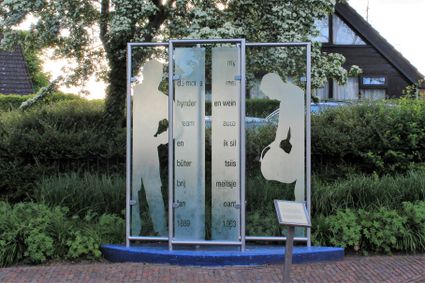
The event made a deep impression on the inhabitants of Oldeholtpade. In 1945, a monument to Berry was erected. And in 1965, a street was named in his honour.
Oldeholtpade
-
The liberation of Leeuwarden
On 11 April 1945, it became clear that German resistance in the north of the Netherlands was limited. On 12 April, the Allies seized this opportunity to advance on Friesland as quickly as possible. One of the main goals was to liberate Leeuwarden. The 9th Canadian Infantry Brigade was designated for this purpose. But things would turn out differently.
On 12 April, the Royal Canadian Dragoons entered Friesland at Noordwolde. They were to conduct reconnaissance with their armoured vehicles and reach the Wadden Sea as quickly as possible. As a result, the German troops in Friesland and Groningen would be separated.
On the night of 14 to 15 April, three Squadrons of the Dragoons were at Suameer. Burgum could not be reached earlier that day, because the bridge at Burgummerdam had been blown up by the Germans.
Meanwhile, all sorts of things were happening in nearby Leeuwarden. On 12 April, the airfield had been blown up by the Germans. And they left the city on 14 April. Leeuwarden would not be defended. The Burgerweeshuis (Civil Orphanage) that had housed several German agencies was set on fire. An attempt to blow up the telephone exchange failed due to an ingenious intervention by the resistance. In the early morning of 15 April, the resistance also took to the streets en masse to occupy important points and to capture Germans who had remained behind.
The Dragoons in Suameer were in contact with the resistance in Leeuwarden. Due to various reports, it was unclear whether there was now heavy fighting in Leeuwarden or whether the Germans had left the city completely. Because the Germans had blown up important bridges on the route from Heerenveen to Leeuwarden, the infantry could not quickly provide assistance.
So, the Dragoons went to take a look for themselves. Initially, a patrol of four vehicles was sent via the Groningerstraatweg into the city around half past eleven. One of the Canadians in those vehicles recorded the following:
"As we entered the city, passing through the concrete barrier by the narrow passageway left for normal traffic, we were met by an almost hysterical patrol of Resistance men [...] In a few moments the news of our arrival had spread through the city, and we were given a fantastic welcome as we rolled slowly forward into the centre of town."A resident of Leeuwarden recalled:
"We lived close to the Groningerstraatweg, where our liberators passed. Many hundreds of us stood there, all happy spectators. All of a sudden, two ladies from the row flung themselves forward and threw their arms around the Canadians' necks, saying: "Oh darlings, you’re here at last!"After the patrol determined that the coast was clear, the entire C Squadron, a detachment of the Royal Canadian Engineers and Regimental Headquarters of Lieutenant-Colonel Landell followed. Leeuwarden had been liberated. After this, thousands took to the streets. One of the Canadians wrote:
"We halted, and were immediately surrounded by laughing, yelling mobs of people, bringing flowers to give to us, and cheering every move. The Resistance men were everywhere, doing their best to keep the people within bounds and off the cars, but their efforts were hardly necessary. I never saw a more satisfying gathering in my life."Leeuwarden had been liberated by the Dragoons through unexpected circumstances. On the night of 15 to 16 April, Canadian infantry moved into the city.
Leeuwarden
-
Rijsterbos
Rijsterbos Rijs
-
Luxe Vakantie Friesland - Blaugers
Luxe Vakantie Friesland - Blaugers Snikzwaag
Book now
-
B&B Zathe de Spieker - van Gogh kamer
B&B Zathe de Spieker - van Gogh kamer Itens
Book now
-
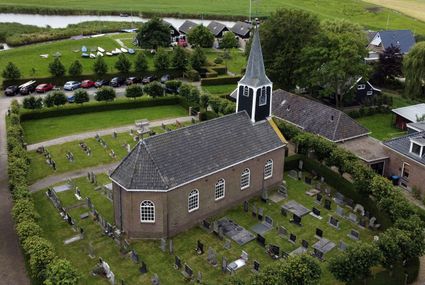
St. Godehardus' Church Marrum
St. Godehardus' Church Marrum Marrum
-
Vakantiewoning Waterwende 29
Vakantiewoning Waterwende 29 Indijk
Book now
-
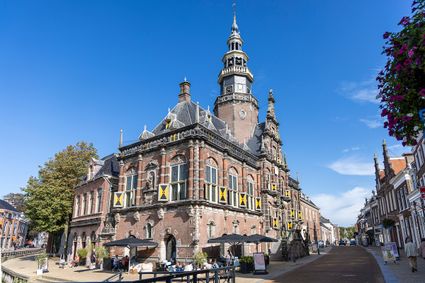
Bolsward (Boalsert)
Bolsward (Boalsert) Bolsward