Locations
1657 to 1680 of 2317 results
-
Opende Blotevoetenpad Barefoot Trail
Opende Blotevoetenpad Barefoot Trail Opende
-
Public toilet on Sint Jozefstraat in Bolsward
Public toilet on Sint Jozefstraat in Bolsward Bolsward
-
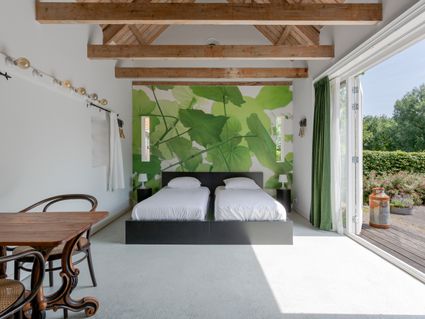
Aqua State - Brekkense Wiel 226
Aqua State - Brekkense Wiel 226 Lemmer
Book now
-
Fries Museum
Fries Museum Leeuwarden
-
Le Boat
Le Boat Hindeloopen
-
Public toilet on Kaeidyk in Workum
Public toilet on Kaeidyk in Workum Workum
-
Rispens polder mill Easterein
Rispens polder mill Easterein Hidaard
-
Grain Carrier’s Cottage (Korendragershuisje)
Grain Carrier’s Cottage (Korendragershuisje) Franeker
-
Weeruusz - Kamer Twa
Weeruusz - Kamer Twa Oudega (gemeente de Fryske Marren)
Book now
-
Easterein (Oosterend)
Easterein (Oosterend) Easterein
-
Remains of the Atlantic Wall in Harlingen
The bunkers at Harlingen were part of the Atlantic Wall: the more than 6,000-kilometer-long German defense line from Norway to Spain. The Atlantic Wall is one of the largest structures of the 20th century.
The line was built during the Second World War between 1942 and 1945 to prevent an Allied invasion of the Western European mainland from the sea. The Atlantic Wall was a series of separate smaller and larger support points that could give each other fire support.
In many cases they consisted of bombproof bunkers, sometimes with a wall and roof thickness of at least two meters of reinforced concrete. Due to a lack of labour, equipment and fuel, only 510 bunkers of the planned 2000 had been built in the Netherlands. In the English Garden in Harlingen is a German bunker that was part of the Atlantic Wall. It concerns a Communications Command Post with which the Germans coordinated the Frisian coastal defences.
Harlingen
-
Age Veldboom Sailing Activities
Age Veldboom Sailing Activities Earnewâld
-
Nooitgedagt chimney
Nooitgedagt chimney IJlst
-
Lazy Lemon
Lazy Lemon Leeuwarden
-
Ferron
Ferron Heerenveen
-
Grachtenrondvaart Sneek
Grachtenrondvaart Sneek Sneek
Book now
-
B&B De Garaazje
B&B De Garaazje Workum
-
Wijn-, Tap- & Eethuis Amicaal
Wijn-, Tap- & Eethuis Amicaal Grou
-
B&B Gaasterland-Hoeve 44
B&B Gaasterland-Hoeve 44 Wijckel
Book now
-
Recreatiepark de Uilenburg - Safaritent Jutrijp
Recreatiepark de Uilenburg - Safaritent Jutrijp Hommerts
Book now
-
Hotel 't Schippershuis - Ruime kamer
Hotel 't Schippershuis - Ruime kamer Terherne
Book now
-
Stichting Beleef IJlst
Stichting Beleef IJlst IJlst
Book now
-
Strandje bij de Fluessen
Strandje bij de Fluessen Elahuizen
-
The liberation of Friesland
By 18 April, the whole province of Friesland had been liberated, except for the Wadden Islands. Compared to other provinces, there was little fighting in Friesland. Overall, the few thousand German troops who had been unable to escape from Friesland were defeated by the Canadians relatively quickly.
The commander of the Royal Canadian Dragoons, Lieutenant Colonel Landell, praised the actions of the resistance by stating that "Friesland liberated herself". While that may be a bit of an exaggeration, the actions of the Frisian resistance undoubtedly accelerated the liberation. And reduced the number of casualties on the Allied side.
At least 31 resistance fighters lost their lives in confrontations with German troops and their Dutch accomplices. At least eleven Canadians and one Frenchman were killed on the Allied side. Dozens of civilian victims were also killed in the fighting and shelling. The number of casualties on the German side is not known, but it is believed that the number ran into hundreds. With 320 destroyed and 4000 damaged homes and 80 destroyed bridges, Friesland was materially the least damaged province of the Netherlands.
Many German soldiers fled towards the western part of the country. The retreating German troops gathered mostly in Harlingen, Makkum and Lemmer. From there, they tried to get away by boat across the IJsselmeer or via the Afsluitdijk to North Holland. The Wadden Islands also became a refuge for collaborators and German soldiers. Here, liberation was longer in coming.
On the island of Terschelling, the last German troops were disarmed by a British artillery regiment on 29 May. Two days later, the British crossed from Terschelling to Vlieland, and the liberation of that island was also a fact. Ameland was liberated on 3 June.
Personnel from the infamous Scholtenhuis, the SD headquarters in Groningen, had entrenched themselves on Schiermonnikoog. After their departure on 31 May, there was a celebration on the island, in spite of the six hundred members of the occupying troops who still were there. Only on 11 June did the last German soldiers leave Schiermonnikoog, and then the whole province of Friesland was free.
Most Canadian units that had liberated Friesland continued the battle in Groningen and North Germany after 18 April. Their war ended on 8 May 1945, when the surrender of all German armed forces became effective.
Eanjum